
Cervicogenic Headache Treatment in Southampton

Cervicogenic Headache Treatment in Southampton
The headache that starts deep in your neck and crawls up the back of your skull. The one that builds through a long day at your desk, or arrives after a night of broken sleep, and settles in behind one eye. You have probably tried painkillers, rest, and hoping it passes. Sometimes it does. Then it comes back.
Cervicogenic headache is a type of headache that originates from structures in the upper cervical spine — the joints, muscles, and connective tissue in the top of your neck — and refers pain upward into the head. It is typically one-sided, often made worse by neck movement or sustained postures, and frequently misidentified as migraine or tension headache. At Southampton Physio, in Bedford Place, we assess and treat cervicogenic headaches regularly — and with the right approach, most people see meaningful improvement.
One further thing worth knowing: cervicogenic headaches can occur alongside migraines. If you experience migraines and also have significant neck stiffness or pain, there may be a cervicogenic component contributing to your headache frequency. Physiotherapy / osteopathy does not treat migraine directly, but current evidence and clinical experience suggest that addressing neck dysfunction — when present — can reduce how often migraines occur.
Is This What You're Feeling?
Cervicogenic headache has a fairly recognisable pattern once you know what to look for. The pain usually begins in the upper neck or base of the skull and spreads upward — often to the back of the head, the side, the forehead, or behind one eye.
You might recognise some of these:
- A dull, aching pain on one side of your head that starts in the neck or base of the skull
- Headaches that arrive or worsen after time at a desk, driving, or looking down at a phone
- Stiffness or reduced movement in your neck, particularly when turning to one side
- Tenderness at the base of the skull or over the upper neck when pressed
- Pain that eases after moving away from a sustained position, then gradually returns
- Mild light or sound sensitivity — less intense than with migraine, but present
- Aching into the same-side shoulder or upper arm alongside the head pain
Cervicogenic headache is often confused with migraine or tension-type headache, and the three can coexist. If you have a long history of headaches and significant neck stiffness or pain, it is worth having the cervical spine assessed specifically — even if previous headache investigations have not identified a clear cause.


Why Does Cervicogenic Headache Develop?
Cervicogenic headache develops when structures in the upper neck — primarily the joints, discs, and muscles at the C1, C2, and C3 levels — become sensitised or overloaded and refer pain upward into the head. The reason this happens is anatomical: the nerves from the upper cervical spine converge with the trigeminal nerve, which carries sensation from the face and head. When the neck is irritated, the brain can interpret that signal as head pain.
Think of it like a cup gradually filling with water. Over time, a combination of factors — sustained postures, reduced neck strength, stress, disrupted sleep, or a past injury — adds to the load. When the cup overflows, that is when the headaches arrive. The pain feels like it is in your head, but the source is in your neck.
This often builds up when:
- You spend long hours at a desk, in a car, or looking down at a screen, loading the upper neck in a sustained position
- Neck muscle strength and endurance have declined over time, leaving the joints to absorb more load than they are built for
- You have had a past whiplash injury — research suggests up to 53% of people with headaches following whiplash have a cervicogenic component
- You have experienced a period of high stress or poor sleep, both of which increase pain sensitivity and reduce your body's tolerance for normal loads
- You have experienced a period of high stress or poor sleep, both of which increase pain sensitivity and reduce your body's tolerance for normal loads
- You have a history of neck stiffness or recurring neck pain that has never been fully addressed.
A 2023 systematic review and meta-analysis of 14 trials, published in Musculoskeletal Science and Practice, found that neck muscle weakness and dysfunction are consistent findings in people with cervicogenic headache — and that addressing these directly produces meaningful, lasting improvements in headache frequency and intensity. That is why our treatment focuses on rebuilding capacity in the neck, not just relieving the headache in the short term.
How Southampton Physio Treats Cervicogenic Headache
Cervicogenic headache responds well to physiotherapy when the assessment identifies the specific structures involved and treatment is structured in clear phases. Here is what that looks like in practice.
Your First Assessment
So we can identify exactly which structures in your neck are contributing to your headaches, and build a plan specific to you.
Your first session lasts around 45 minutes. We will take a detailed history — how the headaches started, what makes them better or worse, whether they are linked to sustained postures or neck movement, and how they are affecting your work, sleep, and daily life. We will also ask about your headache pattern specifically: whether they are one-sided, where the pain begins, and whether you have a history of migraine or other headache types.
From there, we will assess your neck movement, strength, and joint function — including specific tests to identify which cervical levels are involved. If your headaches occur alongside back issues or nerve pain, we will assess those as well. We screen for red flags at this stage and will refer you to your GP or a specialist if anything needs further investigation.
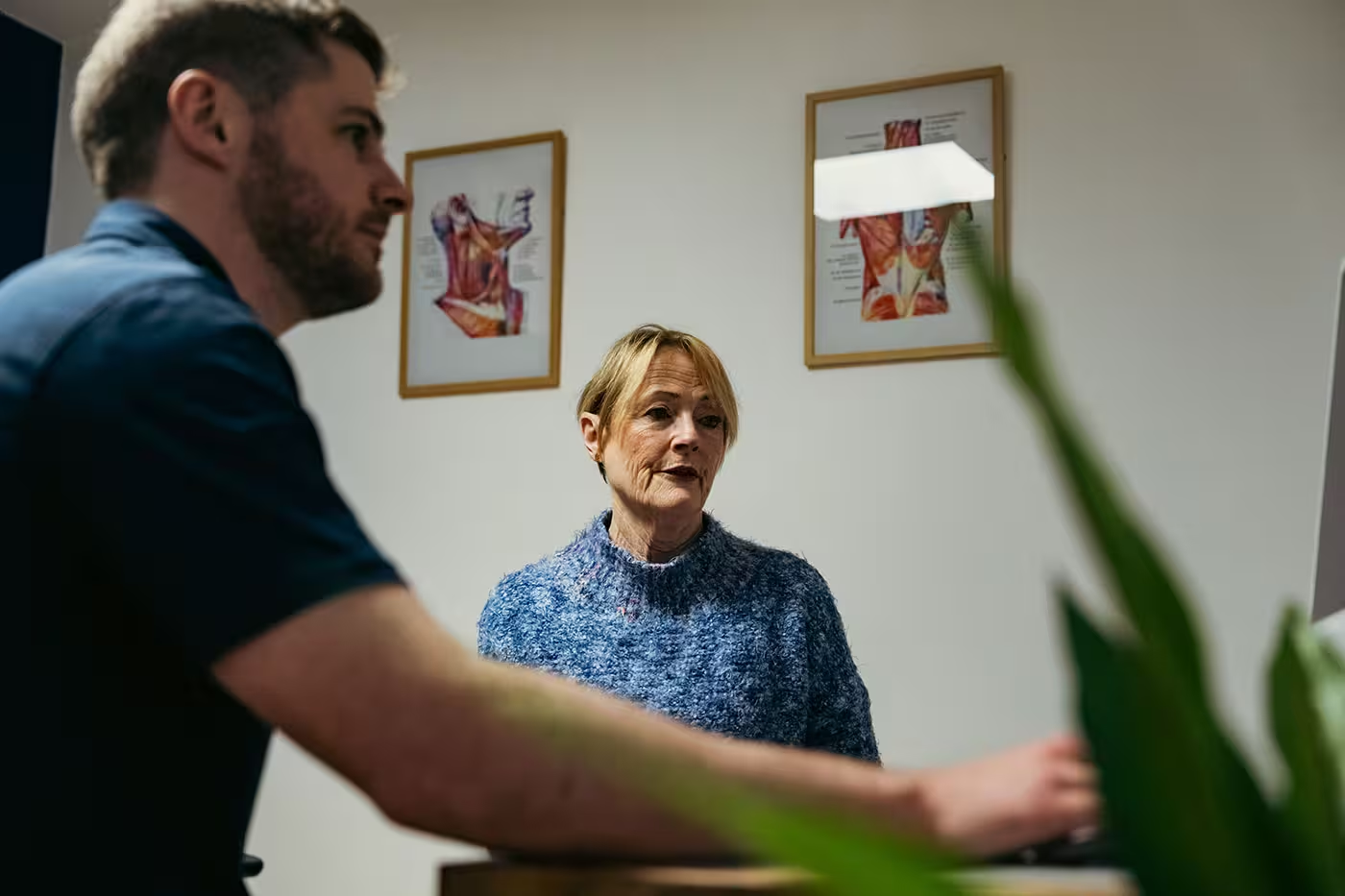
Ian, who runs Southampton Physio, has experienced cervicogenic headaches himself. He knows how much they can affect your concentration, your sleep, and your day — and he brings that understanding into the assessment. When you describe what these headaches are doing to you, he gets it.
Hands-On Treatment
To settle symptoms, reduce joint sensitivity, and prepare your neck for the strengthening work ahead.
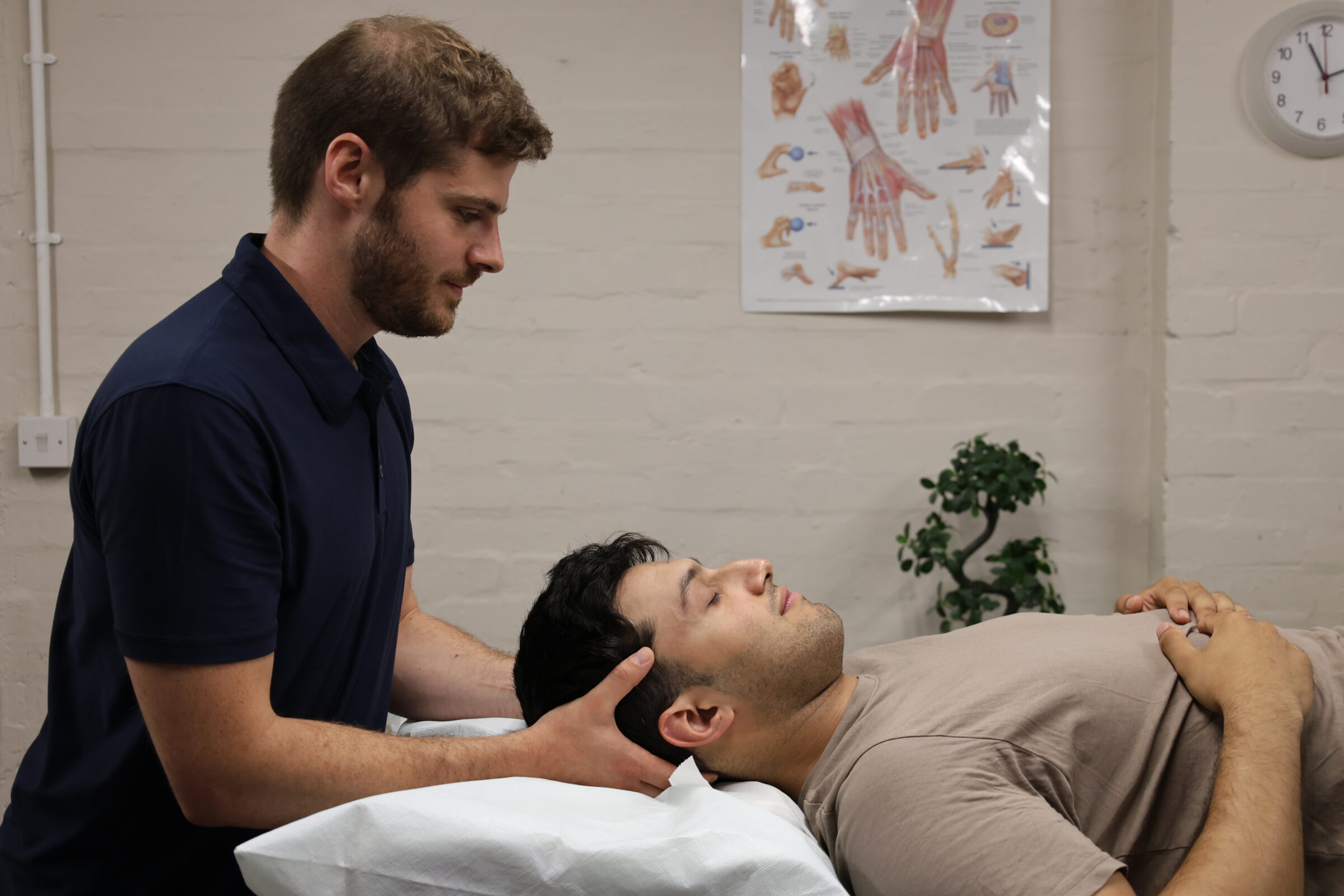
Manual therapy is particularly effective in the early phase of treatment. Depending on your presentation, this may include cervical mobilisation, SNAG-style techniques (where the clinician guides your neck through movement while applying a sustained joint glide), or targeted soft tissue work to the upper cervical musculature.
A 2025 network meta-analysis of 1,297 patients found that cervical spine manipulation and SNAG mobilisation ranked among the most effective interventions for reducing cervicogenic headache pain and disability — with benefits maintained over time. We use these techniques as a bridge: they reduce pain and improve movement, which allows you to get more from the exercise work that follows.
Manual therapy alone will not resolve cervicogenic headache long-term. It is a valuable tool for creating the conditions for recovery — not the recovery itself.
Building Long-Term Strength
So this does not keep coming back.
The foundation of lasting change in cervicogenic headache is progressive loading of the neck musculature. We work in a clear sequence.
Deep neck flexor strengthening comes first. These are the small stabilising muscles at the front of the cervical spine. Research consistently identifies weakness here as a key driver of cervicogenic headache, and targeted strengthening produces clinically meaningful reductions in headache frequency and intensity.
Global neck and upper trapezius work follows — building the broader capacity and load tolerance of the neck and shoulder girdle, so your neck can handle a full day at a desk or behind the wheel without overloading the joints that refer pain into your head.
Neckslevel training is something we offer that very few clinics in the UK have access to. The Neckslevel is a specialist resistance device designed specifically for progressive neck strengthening — think of it as a reformer Pilates machine for your neck. It allows precise, controlled loading across the full range of neck movement, making it particularly effective for building the strength and endurance that cervicogenic headache patients need. If you have tried neck strengthening exercises before without lasting results, this level of targeted loading often makes the difference.
Sensorimotor retraining is incorporated for persistent or complex cases. This addresses the way your brain and neck muscles communicate — specifically the fine-tuned coordination and positional awareness that can be disrupted after a whiplash injury or in long-duration headache presentations. It is a more sophisticated layer of rehabilitation that we add when the clinical picture indicates it.
For most people, the full programme runs over 6–12 weeks. For those with a longer history of cervicogenic headaches, or where previous treatments have not produced lasting results, we can offer a more comprehensive pathway that brings together our physiotherapists, osteopaths, sports therapists, and strength coaches over a longer period — designed to address the root cause properly, not just manage symptoms.

What You Can Start Doing Today
You do not need to wait for your first appointment to start making a difference. These three actions are safe, evidence-supported, and can help reduce the frequency and intensity of cervicogenic headaches in the short term.
Manage your neck load through the day. If you work at a desk or spend long hours driving, the sustained position you hold your neck in is likely contributing to your headaches. You do not need to drastically change your setup — but breaking up long periods of static posture every 30–45 minutes with a brief change in position or a gentle neck movement can reduce cumulative load significantly.
Try gentle chin tucks. This is a basic deep neck flexor activation exercise. Sitting upright, gently draw your chin back (as if making a slight double chin), hold for 5 seconds, then release. Repeat 10 times, two to three times a day. This activates the stabilising muscles at the front of the cervical spine — the same muscles that targeted rehabilitation focuses on — and many people notice a reduction in headache intensity with consistent practice.
Address your sleep position. Sleeping with a pillow that keeps your neck in a sustained rotation or flexion can be a significant driver of morning headaches. A supportive pillow that keeps your neck neutral — roughly aligned with the rest of your spine — makes a meaningful difference for many people with cervicogenic headaches.
These steps are not a substitute for a proper assessment and structured rehabilitation plan. But they will help you move forward in the meantime, and they are the kind of practical self-management tools we will build on together in clinic.
Why Choose Southampton Physio for Cervicogenic Headache?
Cervicogenic headache is one of the most frequently mismanaged headache types — often because the neck is never properly assessed. At Southampton Physio, in Bedford Place, it is an area we know well.
Ian, who leads the clinic, has experienced cervicogenic headaches himself. That matters because when you describe how they affect your concentration, your sleep, your ability to get through a working day, he is not just listening clinically — he understands. His approach combines thorough assessment, evidence-based manual therapy, and a structured strengthening programme that addresses the root cause rather than managing symptoms.
Our team includes chartered physiotherapists, a registered osteopath, sports therapists, and a strength coach — all working together under one roof. For cervicogenic headache, that means we can manage the full spectrum: from acute flare-up through to the long-term strengthening and sensorimotor work that prevents recurrence.
We are also one of very few clinics in the UK to use the Neckslevel, a specialist resistance device for progressive neck strengthening. If you have been doing neck exercises without lasting results, this changes what is possible.
“Very happy customer, I’ve gone from not being able to do any exercise to martial arts training – all thanks to Ian…
I’ve been working with Ian for the last 5 months and the difference is amazing. I came to him with chronic neck pain which was also causing headaches and other issues. I was unable to do any exercise and was getting very frustrated.
Ian was very professional and understanding, he came up with a treatment program that worked for me and guided me through some other aspects of my recovery
I’m now at the point where I can start exercising (including martial arts training) again, and if any issues arise I can use the relief techniques Ian put together for me.” – Gareth B. (Google Review)
“Fantastic! Ian is extremely knowledgeable and takes all aspects of the body functioning (or not) seriously. He has fixed my shoulder and neck problems within just a few weeks and taught me how to prevent the issues from recurring. At every step, I’ve felt very well taken care of.” – Annika W. (Google review)
Frequently Asked Questions About Cervicogenic Headache in Southampton
What is a cervicogenic headache, and how is it different from a migraine?
A cervicogenic headache is a secondary headache — meaning the pain originates from structures in the upper cervical spine (the joints, muscles, and connective tissue in the top of your neck) and is referred upward into the head. Unlike migraine, it is not caused by a neurological event in the brain. The key differences are that cervicogenic headaches are typically provoked by neck movement or sustained postures, often one-sided, and accompanied by neck stiffness or restricted movement. Migraines tend to come with more intense nausea, light and sound sensitivity, and visual disturbance. The two conditions can coexist — which is one reason a thorough assessment matters.
Can physiotherapy help if I have migraines as well as neck-related headaches?
Physiotherapy does not treat migraine directly. However, for some people, a cervicogenic component is present alongside migraine — and current evidence and clinical experience suggest that treating the neck can reduce how often migraines occur in these cases. If you have a significant history of neck stiffness, reduced neck movement, or pain at the base of the skull alongside your migraines, it is worth having a cervical spine assessment to see whether there is a component that physiotherapy can address.
What causes cervicogenic headaches?
Cervicogenic headaches develop when the upper cervical joints, discs, or muscles become sensitised or overloaded and refer pain into the head. Common contributors include prolonged desk or driving postures, reduced neck muscle strength and endurance, past whiplash injury, and periods of high stress or disrupted sleep. Research suggests up to 53% of people with headaches following whiplash have a cervicogenic component. The condition is rarely caused by a single structural problem — it is usually the result of accumulated load on a neck that has lost its capacity to cope.
How is a cervicogenic headache diagnosed?
There is no single scan or test that confirms a cervicogenic headache. Diagnosis is clinical — based on your history, the pattern of your headaches, and a physical assessment of your cervical spine. Key findings include headache provoked by neck movement or sustained posture, tenderness over the upper cervical joints, and restricted neck mobility. At Southampton Physio, we also screen for red flags and will refer you to your GP or a neurologist if anything suggests the headaches have a different cause that needs further investigation.
Do I need a scan or MRI?
Most people with cervicogenic headache do not need imaging. The condition is diagnosed based on clinical assessment, and scans rarely change the management approach. Scans are appropriate if we suspect a structural problem that requires medical or surgical input — such as significant disc pathology, cord compression, or instability — or if red flag symptoms are present. We will advise you clearly if we think imaging is warranted.
How long does cervicogenic headache take to improve?
Most people see meaningful improvement in headache frequency and intensity over 6–12 weeks with a structured programme of manual therapy and progressive neck strengthening. More persistent or complex cases — particularly where symptoms have been present for years or where there has been a significant whiplash injury — may take longer. The key factors are consistency with exercises between sessions and progressive loading over time, rather than the hands-on treatment alone.
How many sessions will I need?
Most people need between six and ten sessions over six to twelve weeks. The first two to three sessions typically combine assessment, manual therapy, and education. From session three or four, the focus shifts to progressive strengthening and exercise progression. We give you a clear estimate at your first appointment and review it as treatment progresses — there are no open-ended commitments
Is it safe to exercise with cervicogenic headaches?
Yes, in most cases. Gentle movement and graded exercise are beneficial — complete rest tends to make cervicogenic headaches worse over time, not better. The key is starting at the right level and progressing carefully. We will advise you on what is safe to continue, what to modify temporarily, and how to build back to full activity. For most people, this includes returning to gym work, running, or sport during treatment, with some adjustments to load and technique
When should I worry that my headache might be something more serious?
Seek urgent medical attention — call 999 or go to A&E — if you experience a sudden, severe headache unlike anything you have had before, or if your headache is accompanied by fever, neck stiffness, a rash, confusion, difficulty speaking, facial drooping, weakness or numbness in an arm or leg, or problems with your vision or balance. Contact your GP or call 111 if you develop progressive weakness or numbness in your arms or hands, if your headaches are consistently worsening over days or weeks, or if you have a new headache pattern with no previous history. At Southampton Physio, we screen for these signs at your first assessment and will always refer you on if we have any concern.
What if I have had cervicogenic headaches for months or years and previous treatment has not worked?
We hear this often. In many cases, previous treatment has focused on symptom relief rather than addressing the underlying drivers — most commonly, the progressive neck muscle weakness and load-tolerance deficit that keeps the headaches returning. Our approach combines thorough assessment, phased manual therapy, and targeted strengthening using specialist equipment, including the Neckslevel device, that most clinics do not have access to. For people with a long history of cervicogenic headaches that have not responded to standard treatment, we can offer a more comprehensive pathway that integrates our full team — physiotherapy, osteopathy, sports therapy, and strength coaching — over a longer period. Let us work out what has been missing and build a plan that goes further.
If you’re still unsure – or just want to speak to a real human – reach out.

Booking
Ready to move without nerve pain?
Cervicogenic headache is genuinely treatable. With a proper assessment, targeted manual therapy, and a structured strengthening programme, most people see a meaningful reduction in headache frequency and intensity — and the tools to keep it that way long term.
Whether you have been dealing with this for a few weeks or several years, the first step is working out exactly what is driving your headaches and building a plan from there.
Book your cervicogenic headache assessment at our Bedford Place clinic in Southampton today.
Call us on 02381 102077 or book online above.